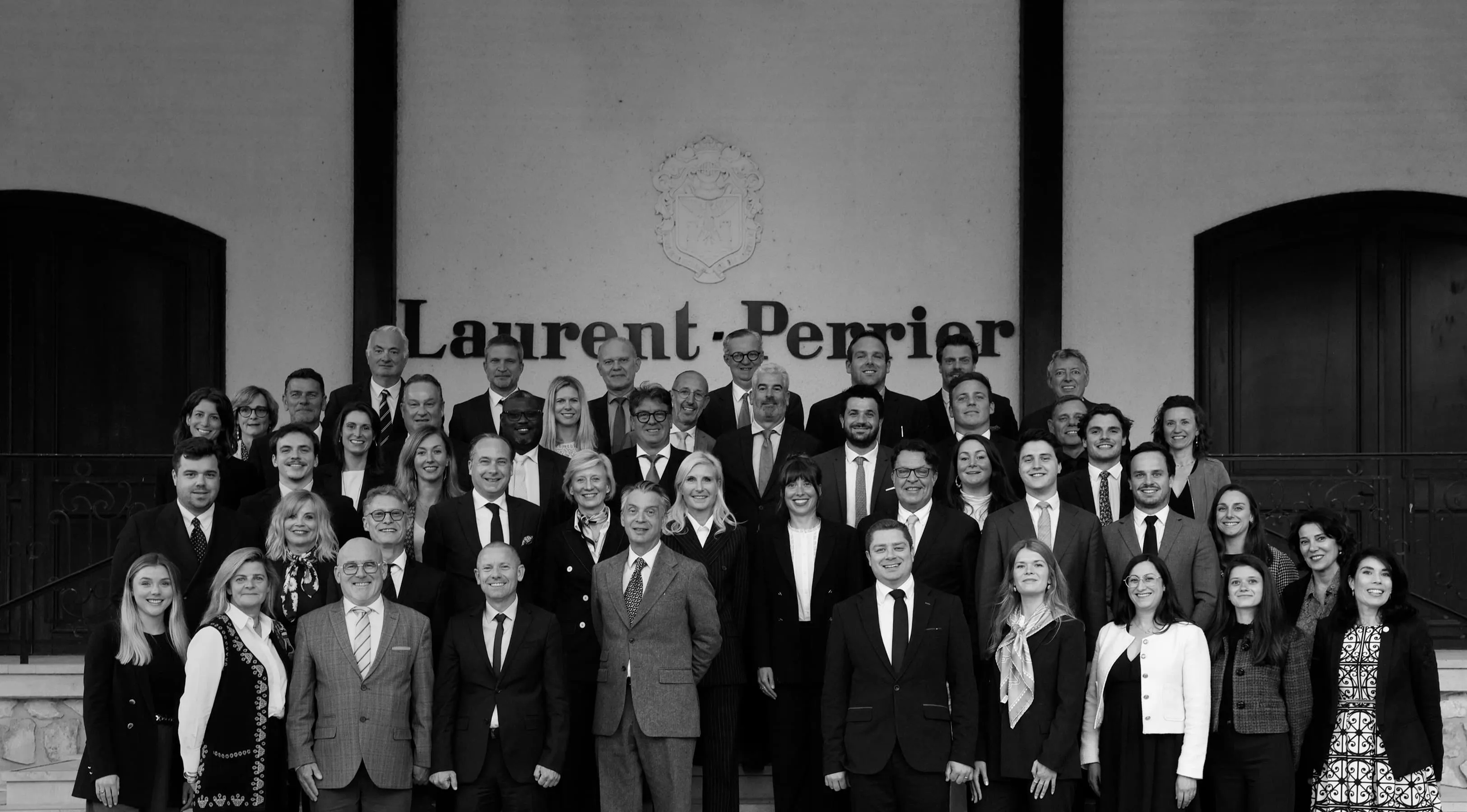
A TEAM DEDICATED TO THE QUALITY OF WINES
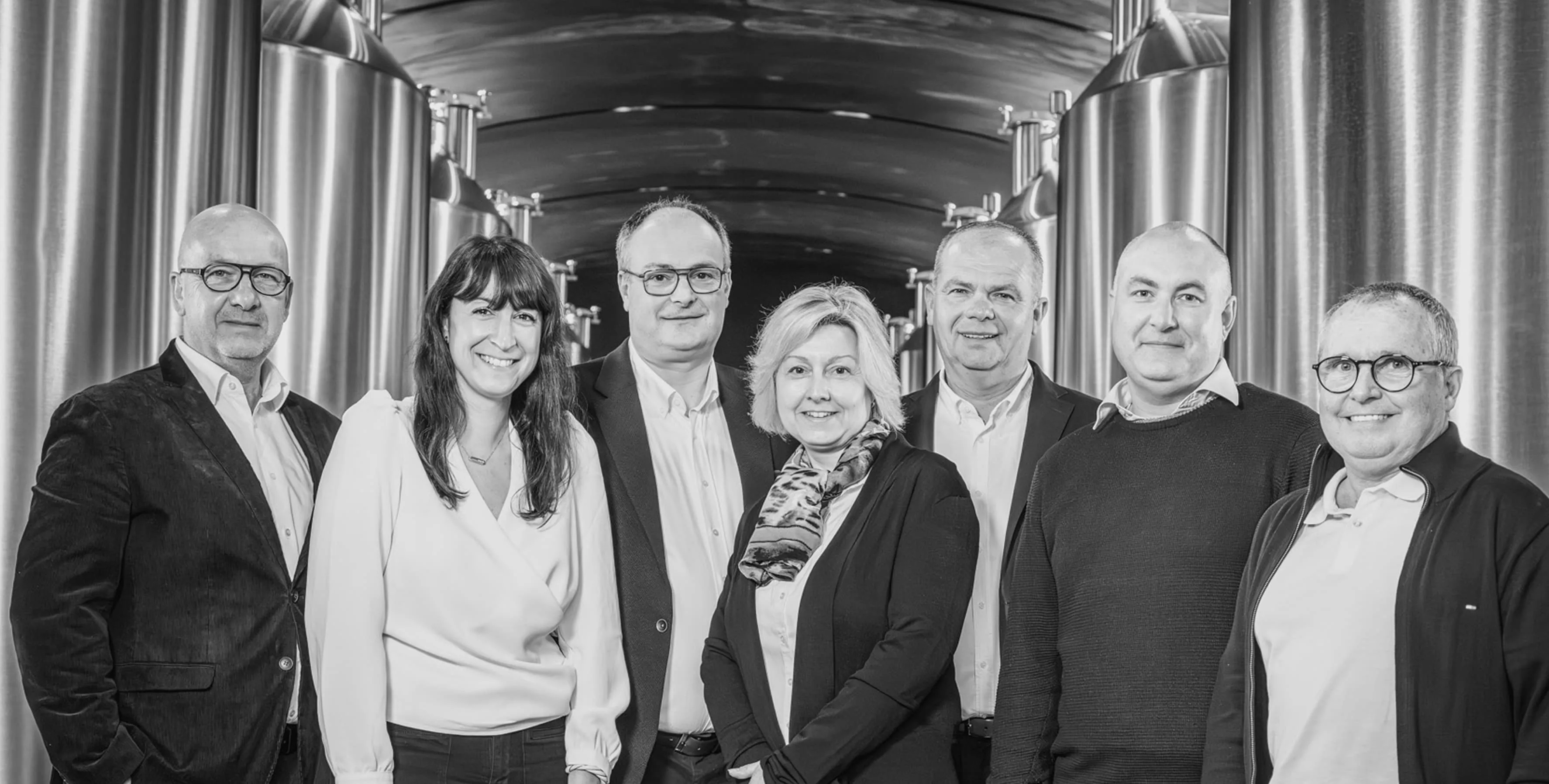
The production team: Emmanuel Robinet, Nelly Gambier, Olivier Vigneron, Christine Carré, Sébastien Cocteau, Benjamin Dorigny, Philippe Gille.

Christine
Carré
Director of
Oenology and
Winemaking
Christine Carré, you are Director of Oenology and Winemaking of
Our wines are recognisable by their way of creation. The blending of reserve wines, stored in stainless steel tanks, offers at the same time freshness and great complexity. Our style is characterised by purity, freshness and elegance, and relies on a majority of Chardonnay.
For
Finally, the non-dosage has been at the heart of our
What is your contribution to each of these three
My job is to “make” the wines of
For the non-dosage of which
For our maceration rosé, the point is for the wine to keep its fresh fruits aromas and to give it structure and elegance.
Finally, for reserve wines, my role is to bring to the Cellar Master in charge of the blending, wines that kept their freshness and aromatic complexity.

Olivier
Vigneron
Technical Director
and Cellar Master
Olivier Vigneron, you are the Technical Director and Cellar Master of
The
Three savoir-faire establish the identity of the House:
First, the blending of reserve wines, to ensure consistency of style, balance, the expression of Champagne terroirs and the complementarity of years. This approach allows the oenological team to have a very wide range of vinified wines, stored in stainless steel tanks to build each Cuvée.
Then, the savoir-faire of maceration of Pinot Noir, which is, as well, specific to our House. It was pioneer in this process.
Maceration results in a complex and very gastronomic rosé, which gives, for example, its highly recognisable signature.
Finally, the non-dosage, which demonstrates a demand for excellence and precision in the selection of grapes and wines on the fine line between ripeness and vivacity.
What is your contribution to each of these three
My contribution as Cellar Master is to carry on the style of

Sébastien
Cocteau
Director of the Vineyards
Sébastien Cocteau, you are Director of the Vineyards of
The 2025 wine-growing year in Champagne confirmed the trend observed in recent years: an early growing season, marked by contrasting weather conditions, yet
successfully managed thanks to the heightened vigilance of the teams at
Thanks to a sunny May, growth resumed at a steady and consistent pace, with good vegetative development throughout two-thirds of the month. However, a cold snap at the end of May slowed flowering in some areas, mainly affecting the Chardonnay. Although slowed, flowering was not halted, but yield potential was negatively affected (flower drop and small berry size) in the earliest-ripening vineyards. The average flowering date across all grape varieties and areas was 4th June.
Veraison began in the first week of August and progressed at a rapid pace. The heatwave in early August significantly accelerated this phase, resulting in very early ripening. Although a slight delay in colour change was initially observed, the first ripeness checks had shown that berry softening was already well underway, indicating that the vine’s physiological transition had effectively taken place. The 2025 vintage will ultimately be marked by an unprecedented rate of daily sugar content accumulation.
Just 81 days after full flowering, the 2025 harvest began
in the second half of August, around 24th August for
This is due to two factors: firstly, the poor floral initiation
during the 2024 growing season (potential number of bunches per vine), and secondly, the occurrence of coulure and millerandage during the 2025 flowering period.
With your experience in Champagne and at
Changes to viticultural practices at the
We are increasing soil cultivation to encourage deep root growth, limiting the use of plant protection products through preventive measures such as early leaf removal, and promoting carefully managed ground cover to regulate water and nitrogen levels.
More broadly, climate change is leading to earlier budbreak, thereby exposing vines to a greater risk of spring frost, as well as accelerating ripening phases (as in 2025) and, at times, causing summer water stress.
Climate change is therefore driving us to fundamentally transform our approach to vineyard management, moving toward a more refined, adaptive, and demanding form of viticulture dedicated to consistent quality.
A TEAM DEDICATED
TO THE BRAND

Michelle
Defeo
Managing Director
How did the USA market fare in 2025-2026?
Nationwide champagne depletions grew at the modest rate of +1.5% in 2025 according to industry data provider SipSource.
How are the premium cuvées progressing on your zone?
The strength of the brand in Nielsen-tracked off-trade consumer pull-through data was remarkable in F26. While the category was flat,
Market share of
How do you see the future?
Our strong F26 performance validates the investments made in our brand and commercial organization in prior years.
Looking ahead to F27, we plan to continue advertising and marketing expenditures that have contributed to the brand’s growth.
Declining sales in the overall US wine market, particularly of low-priced wines, led to rapid distributor closures and consolidation in F26 that is expected to continue.
Tariffs ranging from 10-15% were applied to all Champagne shipments to the US from April 2025 through February 2026. While these payments will eventually be refunded following the decision of the US Supreme Court, new
tariffs of 10% went into effect at the end of February 2026. These are expected to last until July 2026, although they are currently being challenged in court. Negotiations between the EU and the US regarding a long-term trade agreement remain ongoing. While the uncertainly surrounding this subject clouds our future view,

Adam Guy
Managing Director
How did the UK market fare in 2025-2026?
Despite the sluggish performance of the UK economy and a lack of positive sentiment, in 2025 shipments of champagne into the UK increased 1.9% (Comité Champagne).
Champagne sales in retail grew (Nielsen), whereas
champagne sales in the on-trade fell (CGA). The higher cost of operating on-trade venues in recent years has inevitably increased the cost of dining out including prices on wine lists, which appears to be reducing visits to on-trade venues and reducing volumes purchased when consumers visit. In contrast consumers are increasingly purchasing champagne in retail to entertain at home or as a gift. Fine wine investment continued to be subdued.
The increasing trend towards wellness may be reducing demand for champagne, although as champagne is often a special occasion drink, it is less exposed to this trend than more frequently consumed drinks. Champagne benefits from the trend towards drinking less but better.
Reducing inflation and interest rates are helping consumers with the cost of living although the conflict in the Middle East is expected to impact inflation. Recent tax changes have reduced demand: many non-doms have left the UK which reduced demand in some prestige locations, and the addition of VAT to school fees has obliged some families to reduce discretionary spend including on champagne.
In this context LPUK grew volumes by more than the market in F26. In retail this was achieved by adding new distribution as well as by increasing promotional frequency and visibility with existing distribution. In the on-trade this was achieved by winning new key accounts, tailoring pricing to reflect the increasing level of supply available from competitors.
How are the premium cuvées progressing on your market?
LPUK focussed its brand resources on demonstrating that it is a serious wine brand: communicating on its three savoir-faire, amplifying its message through partnerships, and using its super premium and Prestige Cuvée champagnes to reinforce this perception.
LPUK grew volumes of both its super premium and its Prestige Cuvée champagnes.
The majority of Héritage sales continue to come from the five-star hotels where it is the pouring champagne. New listings were won with venues that offer Héritage as an upsell. Retail sales came predominantly from one national retail listing.
Blanc de Blancs Brut Nature sales growth was helped by securing a national retail listing.
Vintage champagne sales were mainly driven by listings in grocery and national retail. The release of Brut Millésimé 2018 generated additional brand exposure. Shipments of rosé champagne into the UK declined in 2025 (Comité Champagne). In contrast sales of
Shipments of Prestige Cuvée champagne into the UK declined by nearly a third in 2025 (Comité Champagne).
Despite this LPUK grew volumes of Grand Siècle and won listings in several Michelin star restaurants where it is included with the tasting menus. In February 2026 LPUK launched Grand Siècle Iteration N°27 with a series of press, trade and consumer events.
How do you see the future?
The frequency of geopolitical shocks is rising, which impacts sentiment and therefore champagne consumption. This creates more uncertainty in forecasting. The UK economy remains sluggish which also reduces demand for champagne. Nonetheless, 2025 saw growth in UK champagne shipments for the first time since 2021, which demonstrates the resilience of the UK champagne market. Based on 2025 performance, we expect the UK market to remain resilient in 2026 and beyond.
In the short term, capacity to increase prices remains limited given availability of supply and sensitivity of demand, particularly in the on-trade.
LPUK is well placed to capitalise on the opportunities in the UK market, in particular with its super premium and Prestige Cuvée champagnes.

Jean-Sébastien
Boileau
Export Director
Africa, Middle East, India
and Australasia
How did the zone Africa, Middle East, India and Australasia fare in 2025-2026?
The zone is divided in four big business units, Africa, the Middle East, the Indian subcontinent and Australasia (Australia, Oceania and New Zealand), the dynamics are very varied in 2025-2026. Their heterogeneity requires a clear distinction to adapt our methods of intervention to each market.
In Africa, the House of
The Indian subcontinent remains structurally limited by a high taxation and a consumption mainly oriented toward local sparkling wines, but tourist archipelagos like the Maldives and the Seychelles represent strategic showcases. Finally, in Australasia, the review of the distribution model and the strengthening of local partners' expertise have allowed Australia to return to robust growth dynamics, recording a significant increase in sales. Overall, the House's differentiated strategy has made it possible to turn heterogeneous contexts into performance levers and to stabilise markets despite their volatility.
How are the premium cuvées progressing on your zone?
Premium cuvées are progressing in a solid way in the entire zone. In Africa, although consumption remains mainly oriented toward categories of Brut and Demi-sec, the demographic evolution and the growth of a superior middle class, point to a gradual transition toward Prestige Cuvées.
In the Middle East,
How do you see the future?
The future appears positive but requires a different approach depending on the market.
In Africa, and in the Middle East, the strength of market positions and premiumisation offer prospects for sustainable growth driven by demographic potential and growing interest in Prestige Cuvées. In the Indian subcontinent, the opening of the market planned for 2027 and the investments in the HORECA network should allow a significative
development in the not-so-distant future. In Australasia, the optimisation of distribution and the consumers’ education are key to maintain the dynamic growth. Overall,

Sezaï Ozkan
Managing Director
Laurent-Perrier Germany,
Switzerland & Austria
How did the zone Germany, Switzerland and Austria fare in 2025-2026?
In 2025 and beginning of 2026 the champagne market is still influenced by escalating global conflicts and local economic uncertainties. Hence the market remains volatile. After a significant volume decline in 2024,
Germany (+1,2% in volume) and Switzerland (+5,2%) recovered a little. Whereas Austria suffered a further decline (-5,1%).
Laurent-Perrier continued its strategy focussing on
premium gastronomy and proceeded with the focus on its premium position gaining further market share in the D-A-CH region. Following this policy promotional activities are further reduced.
How are the premium cuvées progressing on your zone?
Following the uncertainties Prestige Cuvées are suffering disproportionately more than standard cuvées. As a result of a negative mix, value growth of champagne remains below volume growth. We observe promotional activities for major players increased significantly. Also,
How do you see the future?
The champagne market is currently impacted negatively by many factors. Long-term I see the market recovering: the interest for premium brands and high end cuvées are still unbowed. Despite all market influences